Personally I don’t see a lot of hope in the anthropecene. In the past few weeks we’ve been told we have 12 years to change or we destroy the planet, that we have so much C02 in the air that planting more trees can’t help and that giraffes are now endangered. I feel helpless, no matter what I and other people do there will always be huge conglomerates who will continue to push pollution to boost revenue and countries like China who are so focused on becoming the world’s power country that earth friendly practices will never be of importance. We will always have people who don’t think before they buy and will heap barely used goods into the tip. I am afraid of the anthropecene as I cannot see a way out of the impact we have on our planet. I can’t see a way of convincing people that the planet is worth it, we have selfies on earth day telling people to use less plastic while their fridges are stocked with “fancy” plastic bottled water. I want an out and I don’t know where or how that will come about.
Huhana Smith for mana taonga
Mana may also reside in people, animals, and inanimate objects, including the physical symbols of identity, such as personal taonga held in museum collections. The Mana Taonga principle readily acknowledges these spiritual dimensions or qualities as within taonga and draws upon them to enliven connections between iwi, hapu or whanau representatives.
Mana Taonga principle recognises the authority that derives from the whakapapa (genealogical reference system) of the creator of the cultural item.
While mana is not a quality that is bestowed on oneself,1 it is linked to personal, highly valued taonga both old and new, where meaning, values, histories, and associated stories about people or the bearer have accumulated and appreciated over generations and time.
This taonga has been charged with the tapu and mana of revered ancestors, and has acquired the history and vitality of each succeeding person within the generation who wears and looks after them. For Glenis, this taonga is not a possession or seen as her own property. As kaitiaki she holds this treasure in trust for future generations, responsible for preserving the knowledge of stories or events, associated with it.
The Mana Taonga principle, however: reminds the museum of its obligation to be aware of historical and contemporary contexts that surround taonga. Particularly those that passed out of Maori hands during times of conflict and social disruption
Mana Taonga also covers language and associated social narra- tives and histories
Maori perspective that the past is not seen as a fixed point, but an important and pervasive dimension of the present and future. Furthermore, the past may be regarded as an ‘ever-present now’.
I can’t find Cassandra Barnett’s chapter
Connections between Mana Taonga and my star ring
The star ring was something that connected my past, present and future. When I was younger I experienced a lot of death, at the age of 3 I lost 2 grandparents, 3 maori elders that I’d grown up knowing and loving and my Mother’s godson to suicide. Every time I would loose someone close to me (this was fairly frequent as all of my grandparents were gone by the time I reached 10) my Mum would take my sister and I outside to look at the stars. The brightest one , she told us, was the person who we’d just lost smiling down at us. From a young age I’ve had an affinity with the stars, I see them as hope. I received the star ring from my mother at a course we did when I was about 15, the course wasn’t amazing but the ring meant the world to me and I would scarcely be without it. At the age of 16 I met a boy and found what I perceived to be love as I had spent most of my life in solitude, barred from social groups by the girls I attended high school with. I gave him the ring to look after because the ring was love, it was far more than just a ring. When he broke up with me he gave the ring back, a symbol that the love was gone and it needed to find new love. When I got sick I used to go outside, sit on the ground and stare at the stars to ground myself, eventually the sickness got to be too much and I was hospitalized. The hospital didn’t allows the ring as the edges were too pointy so I gave it to a friend who cleansed it under the moonlight, she now had the love. One day I was allowed to leave the hospital so we attended a film where she lost the ring, she too would leave me mere months after. The ring has never returned and it isn’t something I can replace. In a way the ring became a spirit or a being, sometimes I feel it with me when I feel lost or isolated.
Social forces at play with the rings
Feminism – women see rings as a means of ownership and no longer want them
Consumerist capatlism – people want more and more expensive things and thus spent more than they can afford on a ring
Conflict and blood diamonds – people are afraid to purchase what may be a blood diamond as they are directly increasing the blood diamond trade
I am choosing option 2 – Further investigate your Assessment One topic
To do this I will work on creating a ring from scratch, I will need to learn more about crafting rings and work on whether I want to cast it or make a bespoke piece where the metal doesn’t have to be melted. I want to gain an insight into the time taken to create a ring and how this can improve wearer experience by making the process more open.
I am aware that I need to look a lot more into “social, political, and economic factors, alongside concepts and practices including mana taonga, ethics and values, kaupapa Māori and other ideas as they arise in the remainder of the course, and reflect on the relevance of the above to your project ideas. Illustrate the discussion with examples from art and design. ”
I will mostly use my own work as a basis of exploration but may draw on other designers who I believe share the same design ethos.
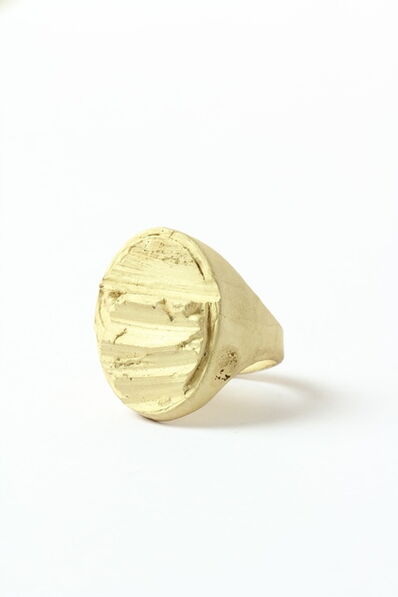
I love how the ring itself is a near perfect circle but the surface is textures in order to create difference – you can change this from person to person in order to have a different look.
I like the look of the shiny and matte surface next to each other – I feel like by editing the colour of the metal or the placements of the shiny pieces you can create entirely new rings
I like the idea of creating a personal surface inside of the ring – the person who wears it has a completely different sense of what it is to someone who sees you wearing it.
Takeaways – texture, surface look (matte, satin, shiny), shape all create unique and different experiences for those who are giving and receiving rings. Instead of casting 7000 of the same ring we can give way to free form design and the idea that we aren’t all the same so what we wear shouldn’t be. Rings can instead be driven by the individual and strive to stay away from consumerist ideal systems. I want love to mean something again, I want resistance from the safety of money hungry society and into the dream of reduce, reuse,recycle that children are taught to believe but not to do.
Born in Germany in 1963, Karl Fritsch trained as a goldsmith and worked for a jeweller before attending the Academy of Fine Arts, Munich, from 1987 to 1994, studying under Hermann Junger and Otto Kunzli.
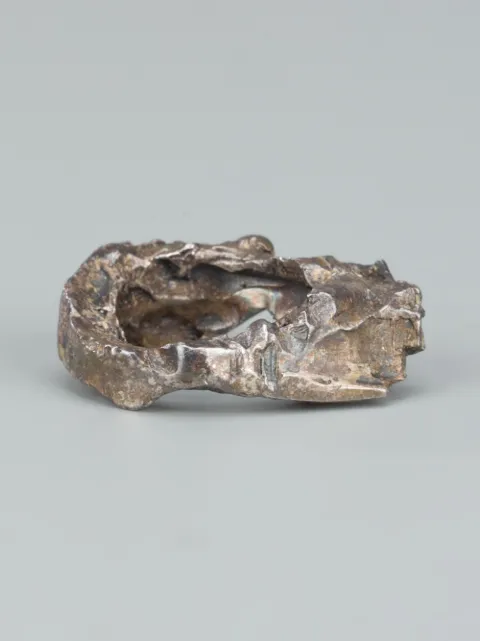
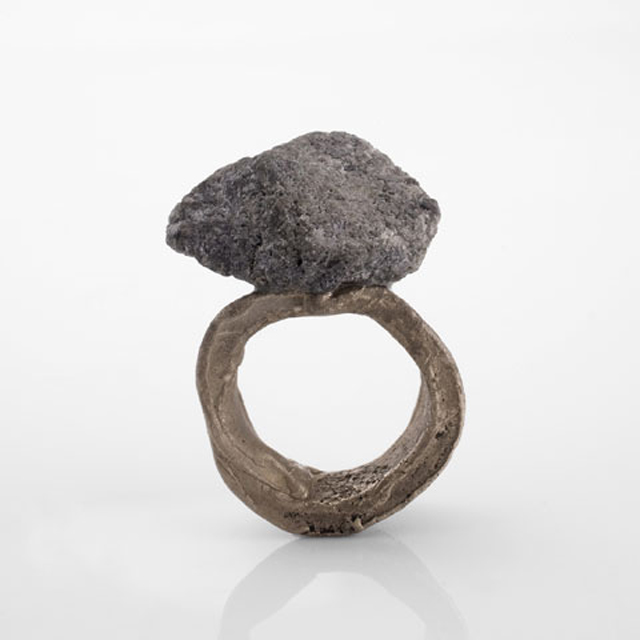
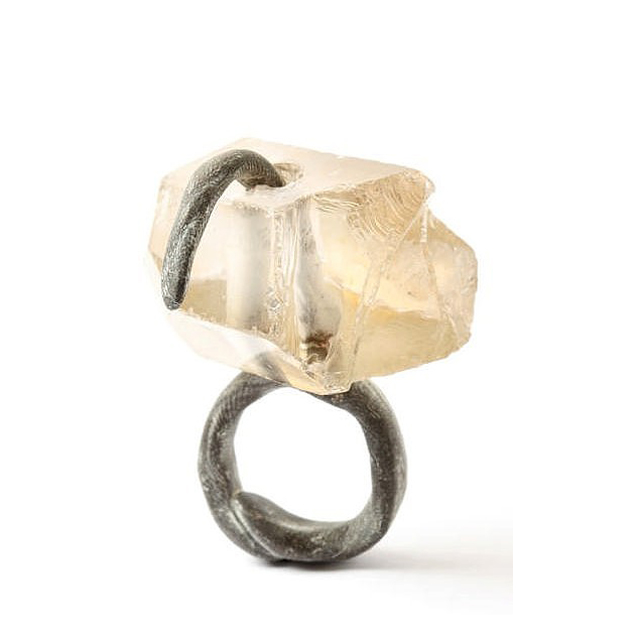
An intuitive remodeller of conventional jewellery, Fritsch creates rings of a sort of damaged beauty that is famously raw-looking. If there is a straight edge in this show, I didn’t see it.
Fritsch has always been interested in vernacular jewellery – meaning not what’s available in the mall, but how someone wears what they buy; how they contextualise it.
He says further that signs of use of an object that he has made help to fully realise it. In other words, his jewellery is meant to be worn.
Fritsch has won many awards and honours, including currently being Adjunct Professor at RMIT, but has he been resting on his laurels since making his home in New Zealand at the end of 2009?
On the contrary, with this huge body of work, including 67 rings, two bracelets, and nine photo assemblages made with New Zealand photographer Gavin Hipkins, you may feel that the move to Wellington has revitalised Fritsch’s practice.
Always an iconoclast and a lateral thinker, Fritsch says that exposure to suburban DIY culture has been an eye-opener, but surely one of the achievements of the conceptual jewellery movement in the past 35 years has been a change in attitudes to materials and methods.
Even so, run your eye down the list of 78 works in this show and you’ll see that gold or silver figure in all but six of them.
New to me is the idea of carving a ring out of a block of aluminium. There are 10 such rings here, made this year and in 2013. The lightness of the material allowed Fritsch to work on an even bigger, chunkier scale than usual. They are set with faceted gems of coloured cubic zirconia of varying sizes.
Compare these carved forms with a ring set with the same stones, but made from darkened silver (catalogue #38). The lumpy, organic shape of the latter is achieved by modelling a design in wax, then making a mould and finally casting the object – a procedure second nature to Fritsch.
In fact, this process, requiring as it does positives (the wax models) and negatives (the moulds) has a parallel in the analogue photographic darkroom processes with which Hipkins produced the images for their collaboration.
It’s also worth remembering another connection with Fritsch’s favoured metal, silver: a solution of silver salts suspended in gelatine is the basis of a traditional black-and-white photographic print.
Hipkins, who teaches in an art school in Auckland and exhibits widely, is a sort of flaneur in the image bank of Western art and culture. Photographs of reproductions of cubist paintings and sculpture, and photographs of photographs (a portrait, a view) were just some of the “second-order” images he supplied.
Fritsch responded to the print not as an image, but as physical material like any other, to, say, embed with stones (see Cosmos, which is mounted on aluminium), or score and gouge, or stick something on.
These collaborative assemblages are presented framed behind glass or pinned to the wall, as with Dead Hare, in which the face of the hare is embellished with dull gold.
While the reference to Joseph Beuys may be unavoidable in this work, it’s also a challenge: to view this exchange between meta-photographer (someone who makes photographs about photography) and jeweller as an insistence on the material basis of any creative practice.
I like how they use the words raw and damaged as love is not perfect and unscathed – societies push to package things in pretty little boxes and ignore the substance inside is something I want to resist against – I want weight and feeling which is something that Karl definitely achieves in his work.
Having writing on a signet ring could be a way of customizing it to the receiver – a word of importance, their names, a shape can all create a piece that differs from receiver to receiver.
Notes from Geologies of power: Blood diamonds, security politics and Zimbabwe’s troubled transition
2007 was a new case of ‘blood diamonds’, whereby state security forces secretly oversaw the extraction and criminal smuggling of rough diamonds – in the process, violently displacing local communities, informal miners and legal title-holders, and depriving the national treasury of significant new revenues and foreign exchange earnings. Unlike other infamous cases like Sierra Leone and Angola, where the illicit trade in diamonds helped fuel armed rebellion, Zimbabwe’s conflict diamonds came to pose a threat to legitimate government from within
the Zimbabwean Government and elite political interests manoeuvred to control both the legal and illegal diamond trade. When state security agencies moved in late 2006 to impose control over illegal informal mining and diamond trading, it soon became apparent that ZANU-PF’s aim was not to eliminate the black market diamond trade, but rather, to facilitate and incorporate such trade within a mining regime dominated by elements of ZANU-PF’s security and political leadership.
Diamonds represented a potential windfall for those who controlled access to them, creating a powerful dynamic of conflict and competition among a variety of actors. These actors included the legal title-holder to the Chiadzwa claim from April 2006, African Consolidated Resources plc (ACR), a British-registered company led by mostly white Zimbabwean nationals, state regulatory and producer structures, such as RBZ, ZMDC and MMCZ, leading state security agencies, including the Zimbabwean National Army (ZNA), Zimbabwe Republic Police (ZRP) and Central Intelligence Organisation (CIO), which were soon tasked with securing the diamond fields, political and allied local business elites, informal or ‘illicit’ miners (known as ‘magweja’), and the profoundly impoverished rural communities surrounding the diamond-bearing areas (Nyamunda and Mukwambo 2012). In particular, ACR had staked a claim to the mining title for an important section of the fields, pegged off and fenced a test mining section and begun preliminary surface operations by mid-2006. But ACR’s control over the fields was cast in doubt soon after the prospect of a major find became publicly known
Reports of continued illegal mining and human rights abuses by the ZRP brought new pressures on, and responses from, the fragile GPA. ZANU-PF, which retained unilateral control of government ministries until February 2009, intensified its militarised involvement in the diamond fields by unleashing a new and profoundly violent assault on black market mining in late October 2008. This time the ZNA led the attack. Operation Hakudzokwi (‘area of no return’) culminated in unprecedented numbers of deaths and human rights abuses in Chiadzwa and surrounding areas.
the spirit and letter of the GPA came to stand as a primary challenge to the partisan illegal accumulation nexus at Marange, while the violent political strategy fuelled by its diamonds placed in doubt the GPA’s goal of a political transition founded on a new democratic constitution and legitimate free and fair elections. ZANU-PF’s continued political and economic profiting from diamonds required power-sharing to be undermined. Marange diamonds therefore emerged as a key ‘litmus test’ of the new GPA: if politicised illegal diamond networks could not be dislodged by the unity government, what hope was there for the wider ‘normalisation’ of the national political economy? (Saunders 2009).
In 2010, the KP allowed two significant allotments of stockpiled Marange diamonds to be sold overseas; by mid-2011, concerted government lobbying at the KP and the assumption of the chairmanship of the organisation by political ally DRC saw new moves to unban rough diamond exports – first via an irregular decree by the KP’s DRC chair; later, at the annual meeting of the KP, by consensus. In November 2011, the KP’s ban was lifted on the sale of existing stockpiles of Marange diamonds and by implication, future irregularly contracted production. With the unblocking of international sales a flood of stones – and poorly monitored revenues – ensued, and evidence soon emerged to suggest that government had already overseen significant exports of non-compliant rough diamonds while working to lift the KP’s sanctions.
Notes from The Fight Against Blood Diamonds Continues.(World / DemocraticRepublic of Congo)
Max Rodriguez… The only thing that troubles him is the issue of the ring. Rodriguez has heard about how diamonds fuel distant conflicts, about the miserable conditions of the miners who wrest the stones from the earth, and he worries. The 34-year-old slips on a gold signet-style ring in the 12th-floor showroom of Vale Jewelry in New York City’s diamond district. “I don’t want a symbol of our union to also be associated with chaos and controversy and pain,” says Rodriguez.
To Mbuyi Mwanza, a 15-year-old who spends his days shoveling and sifting gravel in small artisanal mines in southwest Democratic Republic of Congo, diamonds symbolize something much more immediate: the opportunity to eat. Mining work is grueling, and he is plagued by backaches, but that is nothing compared with the pain of seeing his family go hungry. His father is blind; his mother abandoned them several years ago. It’s been three months since Mwanza last found a diamond, and his debts—for food, for medicine for his father—are piling up. A large stone, maybe a carat, could earn him $100, he says, enough to let him dream about going back to school.
Mwanza and Rodriguez are on opposite ends of an $81.4 billion-a-year industry that links the mines of Africa, home to 65% of the world’s diamonds, with the sparkling salesrooms of high-end jewelry retailers around the world. It is an industry that was supposed to be cleaned up
2003 the diamond industry established the Kimberley Process, an international certification system designed to reassure consumers that the diamonds they bought were conflictfree. But more than 10 years later, while the process did reduce the number of conflict diamonds on the market, it remains riddled with loopholes, unable to stop many diamonds mined in war zones or under other egregious circumstances from being sold in international markets
“If people stop buying our diamonds, we won’t be able to eat,” says Mwanza. “We still won’t be able to go to school. How does that help us?” In an age of supply-chain transparency, when a $4 latte can come with an explanation of where the coffee was grown and how, even luxury goods like diamonds are under pressure to prove that they can be sustainable. The Kimberley Process has gone some of the way, yet a truly fair-trade system would not only ban diamonds mined in conflict areas but also allow conscientious consumers to buy diamonds that could improve the working and living conditions of artisanal miners like Mwanza. But the hard truth is that years after the term blood diamond breached the public consciousness, there is almost no way to know for sure that you’re buying a diamond without blood on it.
$81.4 billion Size of the global diamond industry in 2014. It employs approximately 10 million people worldwide
3 1.9% Growth in the U.S. fine-jewelry market from 2004 to 2013, at a time when sales of other luxury items like electronics and fine wines increased over 10%
140,000 carats Total weight of conflict diamonds smuggled out of the war-torn Central African Republic, according to a 2014 U.N. report
65% Percentage of the world’s diamonds that are found in Africa, with Botswana, the Democratic Republic of Congo and South Africa among the leaders
According to Congo’s Ministry of Mines, nearly 10% of the population relies on income from diamonds, and the country produces about a fifth of the world’s industrial diamonds. Diamonds may bring problems, but rejecting them outright would bring even more
Diamonds that come from Zimbabwe and Angola are particularly problematic. Watchdog groups have documented human-rights abuses in and around mines in those countries, though exports from both nations are allowed under the Kimberley Process—another loophole in the system.
These sources were useful for showing that not only are blood diamonds still a reoccurring issue but they’re something that we don’t have a definitive solution for. In Zimbabwe these diamonds are driven by government greed and result in the deaths of people who do not stick to government sanctions on mining. It also shows that sources deemed “reputable” may be falsified in order to make a section of the country or government wealthier.
On the other hand blood diamonds in the Congo are a double edged sword in the sense that children are being forced out of school and into mining diamonds in order to fend for themselves and their families but the removal of the diamond minds poses a bigger issue of a lack of sustenance due to diamonds being one of the Congo’s largest financial sectors. People here need diamonds to eat but diamonds also create mass ailments. Perhaps a better option is to remove diamonds all together and create a notion of each wedding ring purchased making compulsory donations towards NGO’s which teach dependent populations how to sustain themselves without the need to mine. An increase on sanctions with breaking the Kimberley Process or creating stricter rules may also help.
Divorce Rate by Country: The World’s 10 Most and Least Divorced Nations
September 29, 2017
We’ve taken a closer look at the divorce trends across the globe. Marriage is becoming less popular and divorce continues to rise. Check out the infographic below:
Every year, world organizations such as the UN record global divorce rates. According to recorded data, the marriage and divorce statistics are dramatically changing due to a number of poignant factors. Most common reasons include:
Incompatibility
Infidelity
Drug/alcohol addiction
Physical/mental abuse
The reasons are quite a lot, and we haven’t even mentioned other irreconcilable factors that cause couples to call it quits and end their marriage.
Even marriage rates have not been stable and are dropping. This, however, does not include figures of marriages that ended through legal separations.
Here’s a divorce rate map, with the list of countries with the highest divorce rate.
Luxembourg: 87%
With a population of approximately 500,000, Luxembourg is actually one of the smallest countries in Europe. It boasts an advanced economy and high purchasing power parity. It’s also one of the states in Europe with the highest population growth rate. And right now, it’s also the top country with the highest divorce rate in the world.
Luxembourg will only allow divorce to take place given that both parties are above 21 years old and married for a minimum of 2 years. Here, the age group of divorcees ranges from 40-49 years old. And like other nations in the world, the rates showed in statistics on marriage are progressively decreasing.
Spain: 65%
When we think of Spain, the first thing that comes to mind is Catholicism. This is mainly the reason why it’s surprising that it ranks second on our list of the nations with the highest world divorce rates. Spain is only a tad lower than the Czech Republic, which divorce rate clocks at 66%.
In a place where Catholics strictly condemn divorce, the rate of marriages ending in divorce rose to 65% since it has been legalised in 1981 and grounds were simplified in 2007. Another contributing factor to marriage rate dropping and divorce rate rising in Spain is the financial difficulty that the country experienced in the recent years.
France: 55%
The third runner-up on our list of world divorce rates is France. Though commonly a travel-goal destination for couples, it appears that not everybody there is happy. As a matter of fact, Paris, the country’s romance capital, has the highest number of divorces filed in all of France, having a crude divorce rate of 1.9 per 1000 resident population.
The legal age for marriage in France is set at a young age of 18. For girls aged between 15-18 and want to marry, they need consent from at least one parent. Modifying this concession is currently in progress.
Russia: 51%
It is said that in the modern society of Russia, a marriage fails in more than every second. But why do Russian couples drift apart? Some say infidelity, poverty, alcoholism, and drug addiction should be blamed for the high divorce rate. A smaller percent of correspondents say couples divorce due to lack of compromise, selfishness, misunderstanding, conflict, and impact of social media.
How long do marriages last in Russia? Research states that one-third of marriages fail in the first 5 years. In the next 5 years, a quarter of marriages come to a conclusion. The divorce rate gradually falls by half in the forthcoming 5 years and further decreases as couples stay together longer.
United States: 46%
The grounds for divorce in the United States are classified into two: at-fault and no-fault. At-fault divorces used to be the only way to put marriage into an end; and if the couple had differences, this prevents both of them from marrying another person legally. However, fault divorces can be avoided with certain defenses.
No-fault divorces, on the other hand, requires no allegation or putting the blame on either party. Common reasons that fall under no-fault category include irreconcilable differences, incompatibility, and unavoidable breakdown of marriage.
Research has it that men who get high incomes are less likely to end up changing their marital status to ‘divorced’. Unfortunately, women with higher incomes have lesser chances of getting married. In most instances, couples with lower income have higher possibility to get a divorce due to financial strains.
Germany: 44%
Through the years, the causes of divorce in Germany has changed through time. The old issues such as alcoholism, infidelity, and violence were taken over by incompatibility and communication issues.
Since unhappy endings are inevitable, the German Law System prevents further occurrence of divorce by having only one ground for divorce. That is, if the couple is unable to resolve their issues, resulting to the breakdown of marriage. Both spouses are required by the Court to appear before a Judge and to state this personally. Here, enumerating the reasons for marriage breakdown is not necessary.
Divorce is acceptable if the couple went through a one-year separation, considering that it is consensual. However, if one spouse disagrees, the law requires a three-year separation.
United Kingdom: 42%
To get a divorce in the UK, you need to be married at least a year and prove to the court that your marriage has broken down due to one of the following reasons:
Adultery
Unacceptable behaviour (e.g. violence, verbal abuse, or addiction to alcohol or drugs)
Desertion (i.e. without any good reason or agreement, to end relationship, or left for more than 2 years)
You lived separately for 2 years (consent from the other party is required)
You lived separately for 5 years (doesn’t matter if one party disagrees)
New Zealand: 42%
In 2013, there were 8,279 divorced couples in New Zealand. Like Germany, NZ accepts only one ground for dissolution of marriage – breakdown or irremediable end of marriage.
A divorce can be filed before the Family Court if the couple has been separated for two years. Both spouses can submit the application, or apply alone if the situation calls for it.
The marriage rate in NZ has been declining steadily since 1971. A lot of factors contribute to this large fall in couples saying “I do”, including:
the substantial increase in informal or de facto relationships
the trend towards delayed marriage
increased numbers of residents not marrying
Australia: 38%
The Marriage and Divorce Statistics Division data show that around 33% of all Australian marriages are anticipated to end in divorce. This rate has been gradually increasing since 1975, especially when the Family Law Act legalised ‘no-fault divorce’, stating that the cause rate of the marriage breakdown was irrelevant to one’s ability to get a divorce. In the year 2010, 50,200 divorces were granted in Australia, which means that 100,400 more people were new divorcees at that time.
As of 2015, Australia’s crude divorce rate went to 2.0, while crude marriage rate rose to 5.2.
Based on a recent Australian study, these issues contribute to the increase in divorce rate Australia:
communication problems
loss of connection
infidelity/trust issues
physical or emotional abuse
alcohol and drug addiction
financial problems
work/time pressures
family interference
physical health or mental health issues
Canada 38%
In Canada, a divorce can only take place for one of these 3 reasons:
Spouses have lived separately for a minimum of 1 year.
One spouse had an affair.
One spouse treated the other with unforgivable cruelty.
A poll organised by the Bank of Montreal reveals that 68% of couples divorced due to financial issues. These issues bring about constant arguments, and then the decision to file for divorce normally follows.
Other reasons resulted from the poll include infidelity, falling out of love, lack of compatibility, and domestic abuse.
Now that we’ve covered the 10 most divorced countries, let’s head to the least most divorced locations in the world.
India: 1%
Contrary to the common misconception, divorce cases in India happen in “love marriages” as compared to “arranged marriages” at most times. Even so, India has the lowest divorce rate in the world to date. In every 1,000 marriages, only 13 ends up in divorce. But why exactly is the rate so low?
Indians abide by the principles of Hindu, which suggests a “one man, one woman” policy. Indian weddings, no matter the religion, take months of pre-marital rituals and a lot more days before the actual wedding. The whole “marriage process”, with the parents of both parties involved, establishes a psychological bond between the couple.
For Indian women, divorce may not be the best option because they would be considered as opposing the rules and tradition of the Indian society. In addition, women have to shoulder the high cost of divorce.
Aside from the time period before application and mediation period, divorce hearings typically take 1-2 months. Even mutual consent divorces take 12-18 months before divorce can take effect. For contested cases, the proceedings can be awful with claims of dowry torture, abuse, theft, etc. and this might drag down for many years.
Chile: 3%
Divorce is a subject that’s normally frowned upon by Chileans. This is perhaps well-developed divorce was only made legal in 2005. However, the Chilean Law System declare that there’s no such thing as no-fault divorce. This means that both parties should prove their grounds for filing a divorce. Acceptable grounds include chronic infidelity, abandonment, and physical abuse.
To date, it’s fair to say that Chileans still have the stigma as far as divorce is concerned.
Colombia: 9%
Why Colombian couples manage to stay together for longer sparks a debate among other nations. Some say that Colombian women are perfect partners because they hold their age very well, they’re family-oriented and more willing to act as a partner. Regardless of the case, it’s evident that couples in this country do a very good job in staying married and keeping their vows.
Mexico: 15%
In a place where a divorce is granted much quicker than the United States, it’s pretty surprising that rates fall this low. Speculations suggest that Mexican couples tend to divorce less due to extreme respect to the Catholic church. Also, in the 1970s, the Mexican Federal law enforced courts to stopped accepting divorce petitions from non-residents.
Turkey: 22%
Known as one of the countries with the highest Muslim population in the world, Turkey appears to have a low divorce rate as well. The number of married couples in Turkey is measured by crude marriage rate, which is simply the total of marriages within a given geographical area. In the case of Turkish people, only 1.46 for every 1,000 marriages tend to resort to divorce. This quite low compared to international rates, especially those of Europe. Why is this the case? People say couples with children choose to make their marriage work out rather than get separated.
Iran: 22%
Tying with the divorce rate in Turkey is Iran. Just recently, the Iranian government modified their laws with the aim to make divorce a harder endeavour and stop the rise of broken marriages.
Even a mutual-consent divorce will not be granted if the couple has not gone through counselling. As such, all spouses who seek to end their marriage are required to sign up for counselling and fix their issues. Common reasons for divorce in Iran are drug addiction, family interference, lack of affection, and domestic violence.
Divorce Remains an Adamant Issue Worldwide
There is no question that divorce, in all forms, remains a stubborn issue that our modern society faces at present. Though it can be purely coincidental, it appears that divorce rates are higher in well developed countries, compared to those that aren’t. The good thing with most government systems is that they’re working towards improving the rates of marriage and divorce so couples will think of divorce as the final ultimate resort.
This article was important as it showed that my target market for this project – the western/first world – is the place where the largest proportion of marriages will break up. In this sense it further pushes the idea that we have to resist against how society conducts its marriage customs and look at finding a way of reducing this – perhaps on a surface level this is pushing away from consumer based greed of wedding rings and looking at a way of sustaining our population without further draining the earth’s resources. Whatever it is this article further reiterates my point that rings and marriage are losing meaning – we need to resist.
The Divorce Rate Is Dropping. That May Not Actually Be Good News
Have you heard that statistic that half of all marriages will end in divorce? It’s wrong. Even if that many marriages ever did disintegrate at one point, they don’t now. Divorce is on the decline and has been since the 1980s in America(when that 50% divorce statistic took hold). Experts now put your chances of uncoupling at about 39% in the U.S. This sounds like such promising news. Families are sticking together! But in practice, this does not mean more people are living happily ever after.
The drop in divorce statistics seems to be, in large part, due to the much-maligned Millennials making their marital vows stick far more often. One recent study says that, compared to their 2008 counterparts, young people in 2016 were 18% less likely to get divorced. That study has not been peer-reviewed but is echoed by the trend in the U.K., which keeps much more robust divorce data. Young Brits’ marriages are 27% more likely to make it through their first decade — the prime divorcing years — than those who got hitched in the ’80s.
So have millennials cracked the code on having and holding as long as they both shall live? Not exactly. One reason divorce is less common among that age group is that marriage — and all of its advantages, from survivor benefits for social security to healthier children to a lower chance of heart attack — is becoming more selective. Once considered a starting block for young people, a launchpad to get them underway as they took the plunge, getting married is now more of a high diving board, a platform for publicly demonstrating that they’ve achieved. The people getting all those marital advantages are those with the most advantages to begin with.
Census figures released on Nov. 14 show that the median age at first marriage in the U.S. is now nearly 30 for men and 28 for women, up from 27 and 25 in 2003. This does not mean that Millennials have stopped living with someone they fancy, though. Cohabiting is becoming a norm in most Westernized countries. In 2018, 15% of folks ages 25 to 34 lived with an unmarried partner, up from 12% a decade earlier. More Americans under 25 cohabit with a partner (9%) than are married to one (7%). Two decades ago, those figures weren’t even close: 5% were cohabiting and 14% were married.
Young couples are delaying marriage not because they’re waiting to find The One, but so that they can feel financially secure. And as jobs for those who stopped their education at high school have become more tenuous, and as income inequality has pushed the have-lots and have-somes further apart, that security recedes further into the distance for a lot of young couples.
So people are living together and if it doesn’t work out, they’re splitting — what’s not to like, right? No alimony. No attorneys. Isn’t that why they’re living together in the first place?
Not exactly. There are two types of cohabitation. The type people do because they’re almost sure they’ve found a good match, but want one more run-through to check, and the type people do because it solves a looming liquidity, logistical or loneliness problem. Studies have shown that low-income couples tend to move in together sooner than college-educated ones. And those couples who move in together sooner are less likely to get married.
All of this would be nothing more than bad news for the wedding venue industry, except that often cohabitees whose togetherness is the result of happenstance rather than planning often become parents. A Brookings Institute analysis found that there’s a 50-50 chance that a child born to a cohabiting couple was not planned. And according to Pew Research, more than one of every two children born to cohabiting parents will endure a parental breakup by age 9, as opposed to only one-in-five born within a marriage. They’re also more likely to be poor: 16% of cohabiting parents are living below the poverty line, while just 8% of married parents are. And should they split up, things get more dire; 27% of solo parents live in poverty.
The other cohabitees, who move in together after dating for a long time as the last stop on the journey before conjoining their lives legally, rarely get pregnant before tying the knot. And they have about the same success with marriage as those who didn’t live together beforehand. This is especially the case if they are wealthy and have a degree. Divorce among college-educated couples who married before they had children is at levels as low as in the 1970s, before the wide adoption of the no-fault statutes made divorce much less of a legal nightmare.
So yes, the people who are getting married are increasingly staying married. But that group is an ever-smaller and more privileged group of individuals. Marriage is becoming one of the many institutions from which the poor, less-educated and disadvantaged are excluded. And this isn’t just sad because more than half of those who have never married would like to be. It’s sad because it compounds the difficulties of those who already face considerable challenges. Marriage, or the long-term committed relationship between two people that it’s meant to support, is both subject to and contributing to inequality. In its current form, it’s making the climb out of poverty just that much steeper. Which is not romantic at all.
I found this article particularly useful as it pushes the idea that people can no longer afford to get married – thus divorce and marriage rates are dropping. Thus, in order to continue the occurrence of marriages we need to find cheaper and more sustainable alternatives such as reusing metal and rings from waste in order to save for “the big day”. Resistance against the desire to spend more than you earn on a wedding will mean that love can still prevail and rings can still be accessible as we won’t be driven by the desire to spend $5000 on a ring.
The Strange (and Formerly Sexist) Economics of Engagement Rings
Diamonds are forever, but the meaning of the diamond engagement ring has changed dramatically in the last century.MATTHEW O’BRIENAPR 5, 2012
Why do men buy diamond rings for our fiancées? There’s the emotional story. We enjoy making grand gestures of commitment to the people we love. Behind that, there’s the marketing story. DeBeers’ historic ad campaign, crafted by the real-life mad men at N.W. Ayers, convinced generations of lovers that diamond bands were synonymous with eternal devotion. But behind that, there is economic story that is just as important and fascinating.
Once upon a time, diamond rings weren’t just gifts. They were, frankly, virginity insurance.
A now-obsolete law called the “Breach of Promise to Marry” once allowed women to sue men for breaking off an engagement. Back then, there was a high premium on women being virgins when they married—or at least when they got engaged. Surveys from the 1940s show that roughly half of engaged couples reported being intimate before the big day. If the groom-to-be walked out after he and the bride-to-be had sex, that left her in a precarious position. From a social angle, she had been permanently “damaged.” From an economic angle, she had lost her market value. So Breach of Promise to Marry was born.
But in the 1930s, states began striking down the “Breach of Promise to Marry” law. By 1945, 16 states representing nearly half of the nation’s population had made Breach of Promise a historical relic. At the same time, the diamond engagement ring began its transformation from decorative to de rigueur. Legal scholar Margaret Brinig doesn’t think that’s a coincidence, and she has the math to prove it. Regressing the percent of people living in states without Breach of Promise against a handful of other variables—including advertising, per capita income and the price of diamonds—Brinig found that this legal change was actually the most significant factor in the rise of the diamond engagement ring. It’s historically plausible. The initial mini-surge in diamond imports came in 1935, four years before DeBeers launched its celebrated advertising campaign. What’s going on here?
Let’s think like an economist. An engaged couple aren’t all that different from a borrower and a lender. The woman is lending her hand in marriage to the man, who promises to tie the knot at a later date. In the days of Breach of Promise, the woman would do this on an unsecured basis — that is, the man didn’t have to pledge any collateral — because the law provided her something akin to bankruptcy protection. Put simply, if the man didn’t fulfill his obligation to marry, the woman had legal recourse. This calculus changed once the law changed. Suddenly, women wanted an upfront financial assurance from their men. Basically, collateral. That way, if the couple never made it down the aisle, she’d at least be left with something. And that something was almost always small and shiny. The diamond ring was insurance.So, should a jilted bride give back the engagement ring? Today, the answer is often yes. But back when rings first came into vogue, part of the point was that she wouldn’t. It was a security against a default on the engagement. The good news is that this seems so alien to us today. Women have their own careers. They earn more degrees. And, for the younger generation, they out-earn men. More importantly, the stigma against premarital sex has disappeared. A broken engagement isn’t a lasting financial disaster for a woman like it was before. The diamond engagement ring has itself undergone a transformation. It’s no longer a security. It’s just about signaling nowadays. It’s anachronistic. But don’t try telling your girlfriend that.
Much depreciated: the goods that drop most in value
From diamond rings to cars, we show you how to take the sting out of purchases that can become worthless faster than yesterday’s wedding dress
Juliet Stott
Sat 17 Oct 2015 07.01 BSTLast modified on Tue 21 Feb 2017 17.46 GMT
Contrary to what the companies say, a diamond is not forever – in terms of material value at least. Photograph: Spencer Platt/Getty Images
Jewellery
New diamond ring: £1,000. A day later: £50
After discovering her husband’s affair, Catherine O’Leary* recently divorced. At least, she thought, her diamond engagement ring would be worth something – after all, it cost £1,000.
But she was horrified when she took it to a jeweller on her local high street. She was initially offered just £30, eventually managing to get the price up to £50. “I was quite insulted, really. It was a lovely ring that had been well looked after. I even had a certificate that verified the diamond’s authenticity,” she says.
It makes something of a mockery of the De Beers ad that ran in the 1990s which marketed diamonds with the strapline: “How else could two months’ salary last forever?”.
Guardian Money carried out its own test: I took my ring, which cost £1,200 and has a .40 carat diamond, and tried to see what I could get hawking it around jewellers in York. I was told it had a “scrap value” for the metal of £85 and, although the diamond was potentially worth £350, in reality it had no value because it was too small.
Sadly, I wouldn’t even realise the value of my ring if I lost it, or if it was stolen, because insurance companies rarely hand over the cash equivalent these days. Many insist on replacing “like for like” directly with the shop.
Jeweller of 38 years Vincent Taylor from York says: “Diamond rings are only worth investing in if you buy them at the right price. Profit margins on the high street are so big that the price you pay is a false price.” His colleague Cavern Gill-Vernon, a trade jeweller of 26 years, says high street jewellers have “profit margins of 300% plus VAT”.
If buying your own diamond, choose a lower grade colour. Diamonds are graded D to Z but only experts can really tell the difference between a D and a G. Opt for a G or H grade. * Not her real name.
I want to create rings that tell a story and can be recycled back to the wearer or a buyer if their intended use fails. For example a wedding ring that doesn’t feature diamonds and other precious gems is less likely to be immediately recognized as a weeding ring. As stated above divorce is highly common and wedding rings depreciate significantly. Say an individual becomes divorced a ring that was used to symbolize a marriage can be moved and resized to fit another finger and they can reuse it or they can resell it and not worry about the drop in monetary worth of rings. Thus these rings are a symbol of love and also an item that can be worn throughout time without the issue of everyone knowing that you’ve moved your wedding ring from one finger to another once divorce occurs.
I feel that wedding rings at the moment lack substance. As looked at previously diamonds are a huge sticking point for consumerism. Rings are no longer driven by love, meaning or individuality but by how many carats you can buy (not necessarily afford as people spend absorbent amounts) and are a means to exploit and show off your ‘wealth’. I believe that rings should be pushed away from stones and ‘bling’ and brought into today’s society that desperately craves waste reductive measures. To do this emphasis should be placed on the weightiness and individuality of a ring so that it’s a constant reminder of love and isn’t going to create an issue of resale and reuse as there won’t be many, if any of the same. Here is my look into recycled jewelry:
5 Designers Making Stunning Jewelry from Recycled Metals
The right accessories can make every piece in your closet do double-duty, taking those jeans from Saturday at the farmers market to Saturday night at your favorite restaurant, turning a simple dress from wedding chic to date-appropriate, and giving a sleek sweater a brand new look.
But just because jewelry can make your clothes look new doesn’t mean it needs to be made of new materials: Add pieces from these designers to your collection and — whether you like chunky bracelets or delicate necklaces, heavy rings or simple stud earrings — you’ll up your style cred instantly.
The piece is inspired by the Japanese concept of wabi sabi, which she describes this way: “As the silence between notes in music is vital, so does the harmony between the created form and the empty space within magnify the intensity of expression.”
Each of her pieces is one-of-a-kind, made from sustainable materials including Fair Trade gold, recycled silver, and sunflower-derived bio-resins, and she wraps the finished product in recycled packaging.
Choose from wedding-worthy wide silver and gold bands, petite stacking rings (like the ones shown here), sparkly stud and hoop earrings, engagement-ready moissanite solitaires, and pretty pendant necklaces.
This is the first thing that comes to mind when I think of the Anthropocene
Where will I go When I don’t want to be With idle hands awaiting catastrophe Here in the Anthropocene
How will we escape this hell we made How will we escape this hell
Is it a park is it a plaza where do I need to be? Is it a pipeline is it some refinery? Well change ain’t coming down from above I’ll no sooner hold office than a molotov
How will we escape this hell we made How will we escape this hell
Pick your poison or pick your pride Soon there’ll be nowhere left to hide Well soil is cleaner than money We need bees for more than their honey
How will we escape this hell this lunacy How will we escape this hell How will we escape this hell they paved How will we escape this hell
This is the song that I first though of when our topic was introduced – I think it pushes the idea that everything we do has a dire impact on our environment “how will we escape this hell”. I used these words to push my idea that we need to resist the urge to keep pushing out products and need to start reusing what we already have.
I wanted to look into rough diamonds mined annually and how much of these are wasted in the process of cutting and polishing. I could find very little on overall waste in the industry but also looked into diamond consumerism worldwide (how much is sold and why, average ring price etc) Here’s what I found:
Below is a production report from De Beers Group who are a key player in the diamond industry:
Q4 2018
Rough diamond production increased 12 per cent to 9.1 million carats, bringing total production for 2018 to 35.3 million carats due to a planned production increase at Orapa2 mine, although this was in the lower half of the production guidance range of 35 to 36 million carats
BOTSWANA (DEBSWANA)
Production increased 15 per cent to 6.3 million carats. Orapa2 production increased 20 per cent to 3.6 million carats, driven by planned favourable grade and higher plant utilisation. Jwaneng production increased nine per cent following an increase in tonnes treated.
NAMIBIA (NAMDEB HOLDINGS)
Production increased three per cent to 505,000 carats, driven by the Mafuta crawler vessel at Debmarine Namibia spending fewer days in port. This was partly offset by the land operations following the transition of Elizabeth Bay to care and maintenance.
SOUTH AFRICA (DE BEERS CONSOLIDATED MINES)
Production increased seven per cent to 1.2 million carats as a result of planned higher grade ore at Venetia.
CANADA
Production increased five per cent to 1.0 million carats due to higher grades at Victor as it reaches the end of its life. This was partially offset by planned lower grades at Gahcho Kué.
SALES
Rough diamond sales volumes totalled 9.9 million carats (9.2 million carats on a consolidated basis3) from three sales cycles, compared with 8.2 million carats (7.5 million carats on a consolidated basis3) from the same number of sales cycles during the equivalent period in 2017. Fourth quarter rough sales revenues increased year on year as the re-phased allocations of some lower value rough diamonds from Sight 7 (in September) were realised in Sights 9 and 10.
For the full year, rough diamond sales volumes were four per cent lower at 33.7 million carats (31.6 million carats on a consolidated basis3) compared with 35.1 million carats (33.1 million carats on a consolidated basis3) in 2017. 2018 sales volumes were also lower than production, driven by lower demand for lower value rough diamonds in the second half of 2018.
The consolidated average realised price of US$171/ct was six per cent higher (2017: US$162/ct), due to a lower proportion of lower value rough diamonds sold in 2018.
2019 GUIDANCE
2019 production guidance is 31 to 33 million carats, subject to trading conditions. The lower production is driven by the process of exiting from the Venetia open pit with the underground becoming the principal source of ore from 2023. Associated with this, an increased proportion of production in 2019 is expected to come from De Beers Group’s joint venture partners,a proportion of which only generate a trading margin, which is lower than the mining margin generated from own mined production.
Below is a Diamond Industry fact sheet – aimed for media use:
THE DIAMOND INDUSTRY FACT SHEET
How large is the diamond industry?
Diamonds are one of the world’s, and specifically Africa’s, major natural resources. An estimated US$13 billion worth of rough diamonds are produced per year, of which approximately US$8.5 billion are from Africa (approximately 65%). The diamond industry employs approximately ten million people around the world, both directly and indirectly, across a wide spectrum of roles from mining to retail.
Global diamond jewelry sales continue to grow, increasing three-fold in the past 25 years, and are currently worth in excess of US$72 billion every year.
What are diamonds used for?
jewelry (due to their rarity and beautiful appearance). In terms of quantity, about 30% of diamonds are of gem quality and are distributed to experts for cutting, polishing and jewelry manufacture.
Why are diamonds unique?
Diamonds are desirable to consumers because they: • Hold deep emotional meaning • Are one of the Earth’s most precious creations • Are unique, just like the person wearing them • Were born at the beginning of time and will last for eternity
Sorting
Once processed at the mine, rough diamonds are delivered to sorting experts to be sorted and valued into different categories in preparation for sale. There are thousands of different categories into which diamonds can be sorted, dependent on size, shape, quality and colour. The majority of diamonds fall within a range of standard colours from colourless to faint yellow or brown tints. Some very rare diamonds, known as ‘fancies’, are bright colours, such are pink, blue or green. A perfectly transparent diamond with no colour or hue is considered to be the purest, but all rough diamonds have some distinguishing marks, known as inclusions, which make each one unique. The best quality diamonds in terms of colour and clarity are distributed to the gem market with an accompanying Kimberley Process certificate to prove that they are from conflict free sources.
Cutting and polishing
Gem quality diamonds are usually distributed to one of the main diamond cutting and trading centres in Antwerp, Mumbai, Tel Aviv, New York, China, Thailand or Johannesburg. Once they arrive at the diamond centres, experts (known as ‘diamantaires’) cut and polish the rough diamonds into shapes, such as the round brilliant, the oval, the pear, the heart and the emerald. Polishing follows cutting, before the diamonds are again classified by their cut, colour, clarity and carat weight – also known as the ‘Four Cs’. These diamonds are typically sold to diamond wholesalers or diamond jewelry manufacturers in one of the 24 registered diamond exchanges (known as bourses) located across the world.
Jewellery manufacturing
Wholesalers or manufacturers buy relatively small amounts of unset, polished diamonds. Wholesalers sell these to jewellery designers, manufacturers or retailers. Manufacturers will produce diamond jewellery designed and commissioned by a retailer or other jewellery designer. They may also create jewellery, designed by in-house teams, and sold direct to retailers. The System of Warranties is used as a declaration on the invoice for each transaction of polished diamonds to assure industry purchasers and consumers that their diamonds are from conflict free sources.
Retailing
The final stage of the diamond pipeline is when diamond jewellery is sold by retailers to the consumer. The value of diamond jewellery sold each year is approximately US$72 billion, which includes the cost of the diamonds, precious metals and other gems. The USA represents the largest market (50%), followed by Japan (15%), Italy (5%), India (3%), China (2%), The Gulf (2%) and other countries (23%). According to independent research, diamond jewellery is the most highly sought-after category of luxury goods, both by women for themselves and by men for gifts.
To promote the trading of diamonds from legitimate sources and to ensure that consumers can be confident in their diamond jewellery purchases, governments, NGOs and the international diamond industry have worked together to implement a ‘certificate of origin’ system, known as the Kimberley Process: The Kimberley Process is a certification system that prevents diamonds from an area of conflict entering the legitimate diamond supply chain. The Kimberley Process ensures that only rough diamonds accompanied by a government-issued certificate can be imported and exported, providing an assurance that the diamonds are from conflict free sources. Under this United Nations mandated system, only countries that are part of the Kimberley Process can import or export rough diamonds. Today, 74 countries are members of the Kimberley Process, ensuring that more than 99% of diamonds are from conflict free sources. Anyone who imports or exports rough diamonds between these countries without a Kimberley Process certificate is breaking the law. In addition to the Kimberley Process, the System of Warranties was developed by the World Diamond Council (WDC) to extend the Kimberley Process conflict free assurance to polished diamonds and provide a means by which consumers can be assured their diamonds are from conflict free sources. Its principal element is a declaration on the invoice accompanying every transaction (apart from the transaction directly to the consumer) of polished diamonds that declares the diamonds are ‘not involved in funding conflict and are in compliance with United Nations resolutions’. The System of Warranties provides assurance that diamonds are from conflict free sources all the way to the diamond jewellery retailer. CIBJO, the World Jewellery Confederation, is an international confederation of national jewellery trade organisations with 40 nations represented. In addition to the national members there are 33 associate members from the commercial organisations. Founded in 1926, CIBJO’s purpose is to encourage harmonisation, promote international cooperation in the jewellery industry, and to consider issues which concern the trade worldwide. Foremost among these is to protect consumer confidence in the industry. The Council for Responsible Jewellery Practices (CRJP, “the Council”) was founded in May 2005 with Members from the diamond and gold jewellery supply chain, from mine to retail. The current 81 Council Members are committed to promoting responsible business practices in a transparent and accountable manner throughout the industry from mine to retail. Their commitment aims to maintain consumer confidence in diamond and gold jewellery products and the trust of all interested stakeholders in their industry.
According to research from Bain & Co., the six largest diamond-consuming regions account for 86% of global retail jewelry purchases, which exceeded $81B for the first time ever in 2014. The Big 6 diamond-buying regions are the United States, China & Hong Kong, India, Japan, the European Union, and the Persian Gulf.
The United States has long been the diamond consumption center of the world. In 2014, the USA accounted for 42% of all diamond jewelry sales, according to De Beers. However, the market share in the United States was considerably higher before the recession of 2009 when industry sales plummeted to just over $50B, much of it due to declining demand in the USA.
Since 2009, U.S. consumers have returned to their love affair with diamonds and sales have improved steadily year over year ever since. According to De Beers, diamond jewelry sales in the U.S. have increased by an average of 5% each year from 2009-2014, despite the fact that jewelry-focused advertising has been declining over the same time period.
The most recent research suggests that diamond jewelry sales in the past year have shifted to lower cost items, set with smaller or lower value diamonds. This has resulted in the current crisis in the diamond pipeline. Even before the crisis, sales of diamond jewelry had still not recovered to pre-crisis levels. This suggests that there may still be room for further growth in the United States.
China has been a key driver of global growth across many industries, including diamonds. From less than 5% of diamond consumption in 2006, China & Hong Kong are expected to exceed 15% in 2015, according to research from Diamond Shades.
Even more impressive are the gains made in India. This nation of nearly 1.3B people has a long tradition of gold jewelry manufacturing and consumption, especially around the marriage “season” in October and November. However, diamonds have rapidly gained in popularity over the past decade. This is due primarily to the preeminence of the Indian diamond manufacturing industry and the increasing income of the nation as a whole.
Japan on the other hand, while still a significant player in the industry, has seen negative consumption growth since pre-crisis levels. Similarly, the EU has had relatively flat diamond sales for over a decade.
Most of the sales growth witnessed since the financial crisis has come from the United States, China, and India. A closer look reveals some very different trends.
Source: Diamond Shades
A Closer Look
Combined, sales in China and India are nearly $20B annually. This compares to approximately $34B in the United States. However, the current population of the U.S. is just 12% of the combined total of China and India, including Hong Kong. Based on current population data, this implies that U.S. consumption is over $100 per person annually, while consumption from China, India, and Hong Kong is less than $8 per person each year.
While much is made in the media about the growing middle class in these developing countries, the reality is that diamond jewelry is not yet a luxury available to the majority of citizens in either nation. As incomes in these countries continue to grow, more and more people will be looking to buy diamonds.
Pullback in China
Some of the growing momentum from China has been deterred by policy changes which were implemented over one and a half years ago against corruption. The government has instructed public officials to behave modestly, while taking legal measures against high ranking officials. These have “contributed” to the slowdown in the growing trend of luxury consumption.
These rules have had an immediate impact on diamond jewelry consumption in the country. The “gift-giving” culture has come to an end. Much of the middle class has shunned the outward appearance of wealth. The growing trend of Chinese consumers purchasing diamond engagement rings has stalled.
“Recycling” in Japan
In Japan, as the population ages and the economy continues to languish, many people are getting rid of unneeded things to focus on a simpler life, a concept known locally as “danshari.” According to Bloomberg, the market for used goods in Japan has increased by 10% annually since 2009. This has led to a huge market for recycled diamond jewelry, most of which is being exported to buyers in China.
Diamonds over gold in India
In India, the rupee has been steadily weakening against the U.S. dollar since mid-2011, making diamonds denominated in U.S. dollars more expensive in the local Indian markets. However, weak gold prices in the world’s number one gold consumption nation have helped spur diamond sales as consumers rush to acquire jewelry at what they perceive to be good value for money. Based on the mass availability of smaller inexpensive diamonds manufactured in India, the country is now the largest consumer of diamonds in the world, in terms of individual pieces, according to Diamond Shades.
The unique characteristics of each of these major diamond-buying regions have an impact on how diamonds are sold around the world and the seasonality of global retail sales.
Seasonal Diamond Buying
Monthly diamond sales in the United States have shown similar trends for many years. December and the Christmas shopping season are by far the most important diamond jewelry selling seasons of the year, and can be responsible for a significant portion of annual profits for many retailers. Interestingly, December is also a strong month for engagement ring sales, as many men choose to propose to their partners during the holiday season.
Diamond jewelry sales show smaller peaks in February, May, and November corresponding to Valentine’s Day, Mother’s Day, and U.S. Thanksgiving (Black Friday and Cyber Monday) respectively. Based on current sales this year in the U.S., many retail specialists, including De Beers, are predicting a positive Christmas sales season for the industry.
In India, where the majority of polished diamonds in the world are manufactured, polishing factories close during the Diwali holiday in October and November, often for several weeks. Sales of polished diamonds are often brisk leading up to the holiday, as manufacturers want to avoid sitting with significant quantities of diamonds in their safes for long periods. Additionally, the Diwali holiday itself is often a strong time for jewelry retailers who need to replenish stocks.
While the U.S. wedding season ranges from June to October, it peaks in the summer months of June, July and August. That said, weddings take place throughout the year. However, in India, monsoon rains and stifling summer temperatures lead to two very pronounced wedding seasons. The main peak takes place over November and December, with another smaller peak in the spring months of April and May.
As diamond gift giving and adornment becomes more prevalent in India, the wedding season takes on increased importance to retailers and polished diamond suppliers.
In China, the key sales season for diamond jewelry revolves around the Chinese lunar new year, which typically begins in late January to early or mid-February, and can last as long as 23 days. In 2015, New Year sales were curtailed considerably compared to previous years owing to the new regulations.
The Muslim holy month of Ramadan, which lasts 30 days and takes place in June and July, has become a significant diamond jewelry selling period, not just in the Muslim world, but in the UK and other parts of Europe as well. Wealthy people from the Middle East are increasingly coming to Europe to buy jewelry leading up to the holiday. According to Euromonitor International, Saudi visitors to the UK were up 22% in the pre-Ramadan rush of 2012. Average prices during the period exceeded £1,900; double the month prior.
Impact on Diamond Retailers
This becomes even more important as research has identified a rapidly changing trend in the retail landscape of the U.S. According to De Beers, the diamond industry in the U.S. is still dominated by small independent jewelers who serve local markets. The proportion of independent store locations across the country rose slightly from 52% in 2007 to 54% in 2015. However, the proportion of sales to these independents fell sharply, from 56% in 2007 to 35% in 2015.
Department store and chain locations were the big winners in this shift, as larger locations used their scale and buying power to generate higher sales despite a small decline in the overall number of storefronts.
This has important potential ramifications for emerging markets like China and India, which have also historically been served mostly by small retailers in local markets. Consolidation has been rapid in these countries, and large retailers are increasingly gaining market share at the expense of smaller single owner locations. In China, Chow Tai Fook has become a household name and is now the world’s largest diamond jewelry retailer without having attempted to expand into international markets.
SUPPLIEDThis 0.52 carat solitaire diamond ring had an insurance valuation of $4995. Dunbar Sloane sold it at auction for $1170.
Diamonds may be forever but in many cases the resale value of a piece of jewellery is likely to plummet by 50 per cent or more the minute the customer walks out of the jeweller’s door.Which is why savvy jewellery buyers are increasingly purchasing at auction, where prices can often sell for a third of what an equivalent piece would cost if bought new from in a traditional jewellery store.
Several auctions houses around the country hold regular jewellery auctions and with their catalogues being available online and most auctioneers accepting phone bids, buyers no longer need to be in the auction room to secure the piece they want. And with prices at auction ranging from $100 to $50,000, there’s usually something for every budget. Some of the biggest bargains to be had are engagement rings.
A couple may have paid $5000 for a new engagement ring in a jewellers, and then the engagement is called off and they take the ring to an auction house to sell, only to learn they may get about $1000 for it.A typical example was a solitaire diamond ring auctioned by Dunbar Sloane last year. The band was 18 carat gold set with a 0.52 carat diamond and it had an insurance valuation of $4995. It sold for $1170.
One of the reasons engagement rings can sell so cheaply is that people often don’t like the idea of buying someone else’s ring.“For a young couple, going to a jeweller’s shop and choosing the engagement ring is all part of the experience. The big problem is when the engagement is broken,” Dunbar Sloane’s jewellery expert Bettina Frith said.
However, the bargains at auction are not limited to engagement rings.” I tell everyone, don’t buy new,” said Fenella Tonkin, the jewellery expert at Cordy’s auctions.
Even those with money to spend on spectacular pieces can find bargains at auctions. One of the pieces sold at a Cordy’s auction last year was a ring with a 2.33 carat diamond, with smaller pave set diamonds an the shoulders of the ring. It had an insurance valuation of nearly $60,000 and sold at auction for $18,000.
Tonkin said some people were superstitious about buying estate jewellery that had belonged to someone else, but she believed such misgivings were misplaced.” They are pieces that have been loved and cherished by their owners and now they are ready to be loved and cherished by new owners,” she said.
Many of the items Cordy’s sells are antique or vintage pieces which can have higher standards of workmanship than modern pieces, and classic designs from periods such as the art deco era could have timeless qualities that mean they never really go out of fashion, Tonkin said.
Most auction houses charge a buyer’s premium on top of the hammer price. This is a way of sharing the auctioneer’s fee between the buyer and seller of a piece. Auctioneers will deduct part of their fee from the selling price before passing on the proceeds to the vendor.
But a portion of their fee is also added to the selling price and so is paid by the buyer. For jewellery, the buyers’s premium is usually around 15 per cent.
There is usually no GST payable on estate (second hand) jewellery, but GST is charged on the buyer’s premium, which pushes it up from 15 per cent to 17.25 per cent of the hammer price.
So if an items sells for $1000 under the hammer, the buyer’s premium will add another $172.50 to the total purchase price the buyer must pay, taking the total cost to $1172.50.
So buyers should factor that into their calculations when deciding how much they are prepared to bid on a particular piece.
The estimated selling prices which auctioneers often include in their catalogues usually exclude the buyer’s premium.
· Dad and I found my ring in a second-hand store in Blenheim in January / February 1994.
· I loved the solitaire diamond, and the way the side pattern transfers from platinum to gold with two single lines (on the band)
· When I tried the ring on for the first time (and asked the previous owner if it was ok with her if I wore/brought it … I felt very peaceful and felt that translated to an “OK”)
· We took the ring to a Blenheim jeweler as it needed a new gold shank (band) – he did a rush job so we could catch the ferry home with the repaired ring
· An advantage of buying an estate piece was the style (I loved the antique setting), and I was able to get a bigger diamond than if we had brought new
· I got the ring and dad got a gramophone
Wedding band
· I wanted diamonds in my wedding band and I couldn’t afford a ring with diamonds and gold … then I had a brainwave
· We had some gold wedding bands in a drawer at our family home (89 Wilson St, Newtown – which we had for 102 years)
· Mum gave her blessing – my wedding band is made up of:
– Mum’s wedding band (Ngaire Pearl Fishenden) your Grandmother
– Mary Scott (nee Canty) – your Great, Great Grandmother (of Irish descent born in the sound of the Beau bells – making her a cockney – on my Dad’s side)
· I designed the ring myself and had the manufacturing jeweler fit the ring to my engagement ring (hence the curve) and I added the two lines where the platinum and gold meet to replicate the engagement ring (making them more of a set)
· I really, really love that my band contains our family history
Judie Fishenden – my Mum
My Mum’s rings are a great example of reusing what we already have available to us – her engagement ring was from a second hand store and pushes the idea that diamonds are not an investment piece as she paid significantly less than she would’ve had she purchased it new.
Her wedding band consists of my ancestors old rings and was designed by her so again pushes the idea of old becoming new, making the most of what we have and that rings mean more if they are tailored to the receiver. Both rings prove that you do not miss out if you don’t buy new – in fact you gain history and love through the act of making old new again.










 Dressing the Anthropocene
